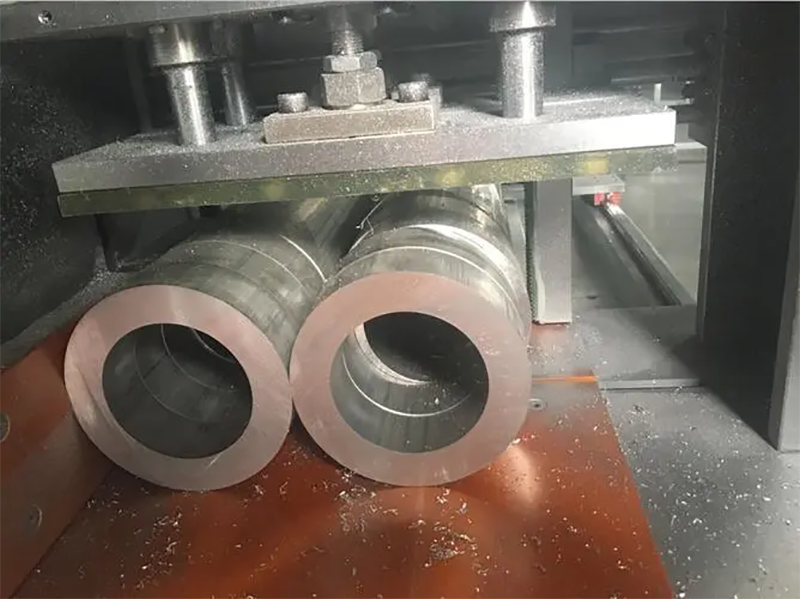
Customer: Automotive body frame manufacturer in Poland
Application Scenario
This Polish manufacturer is a Tier 2 supplier for European new energy vehicle OEMs. It produces lightweight aluminium body frames, battery pack support frames and chassis structural beams. The workshop processes 6061-T6 and 6063-T6 extruded aluminium profiles for frame assembly, including straight cuts and 45-degree miter cuts. Production follows JIT delivery rules to supply finished cut profiles to automotive assembly plants across Poland and Germany. Mixed small-to-medium batch orders of different profile sizes are common on the production line.
Customer Pain Points
- Old manual mitre saws delivered unstable cutting accuracy. Length tolerance reached over ±0.2 mm, and angle errors caused assembly gaps during body frame fitting, leading to high rework rates.
- Heavy burrs and chatter marks appeared on aluminium cut surfaces. Aluminium material stuck easily to saw blades, requiring extra manual deburring and increasing labour cost.
- Simple clamping structure deformed thin-wall aluminium profiles. Unstable positioning raised scrap rates for high-value automotive structural profiles.
- Manual measurement and manual clamping took long setup time. The workshop could not switch quickly between different frame profile specifications for mixed batch production.
- Aluminium chips spread around the workstation. Poor chip collection created cleaning workload and hidden safety hazards.
Problems Solved by Clayton MC455CNC


- CNC automatic feeding brings cutting tolerance controlled within ±0.05 mm. Length and angle consistency fully meets automotive body frame drawing requirements, and assembly rework is greatly reduced.
- Optimised saw blade running track and stable cutting speed minimise burrs. Post-cut deburring workload is cut significantly.
- Dual-direction pneumatic clamping with adjustable clamping force fixes profiles firmly without squeezing thin-wall aluminium, lowering the scrap rate.
- Built-in CNC program library stores parameters for all frame profiles. Operators can call saved programs to switch product specifications rapidly, matching mixed-batch JIT production.
- Integrated high-power chip extraction system collects aluminium chips in real time. The workshop keeps tidy and meets European factory safety standards.
- Automatic feeding and cutting reduce repetitive manual work, easing the pressure of skilled labour shortage in Poland’s manufacturing sector.
Technical data:
| Project | Unit | Full – automatic CNC |
| Maximum sawing height | mm | 100 |
| Maximum cutting width | mm | 250 |
| sawing motor speed | RPM | 50HZ 3200RPM 60HZ 3200RPM |
| Motor power motor | kw | 4KW |
| Servo motor power | KW | 0.75 |
| Workbench area | 645×668mm | |
| table height | 860mm | |
| Maximum stroke of single feeding | 500mm | |
| required air pressure | 6-8Kg/cm2 | |
| Feeding accuracy | mm | ±0.1 |
| Feeding speed | mm/s | 200 |
| Use of saw blade | mm | Outer diameter φ355-φ405mm Inner hole φ25.4mm |
| Machine weight | Kg | 800 |
| Machine size | mm | 1950*1300*1800 |
FAQ
Q1: What types of aluminium profiles can the MC455CNC cut? A1: It is designed for extruded aluminium profiles such as 6061, 6063, widely used for automotive frames, battery brackets and window frames. It can also process copper and other non-ferrous profiles.
Q3: What is the feeding accuracy? A3: Feeding accuracy is ±0.05 mm, which satisfies tight tolerance requirements for automotive structural parts.
Q4: Can this machine handle mixed batch production? A4: Yes. The CNC system saves multiple cutting programs. Operators can switch jobs quickly without repeated manual measurement.
Q5: Does it need an independent dust collector? A5: It comes with an integrated chip extraction unit. It can connect to an external central dust system if required by the factory.
Q6: Is after-sales service available for customers in Poland? A6: We provide English technical manuals, remote CNC troubleshooting and local European partner on-site support for installation and maintenance.
Q7: What air pressure does the machine require? A7: Working air pressure: 5–8 bar.


Leave a Reply