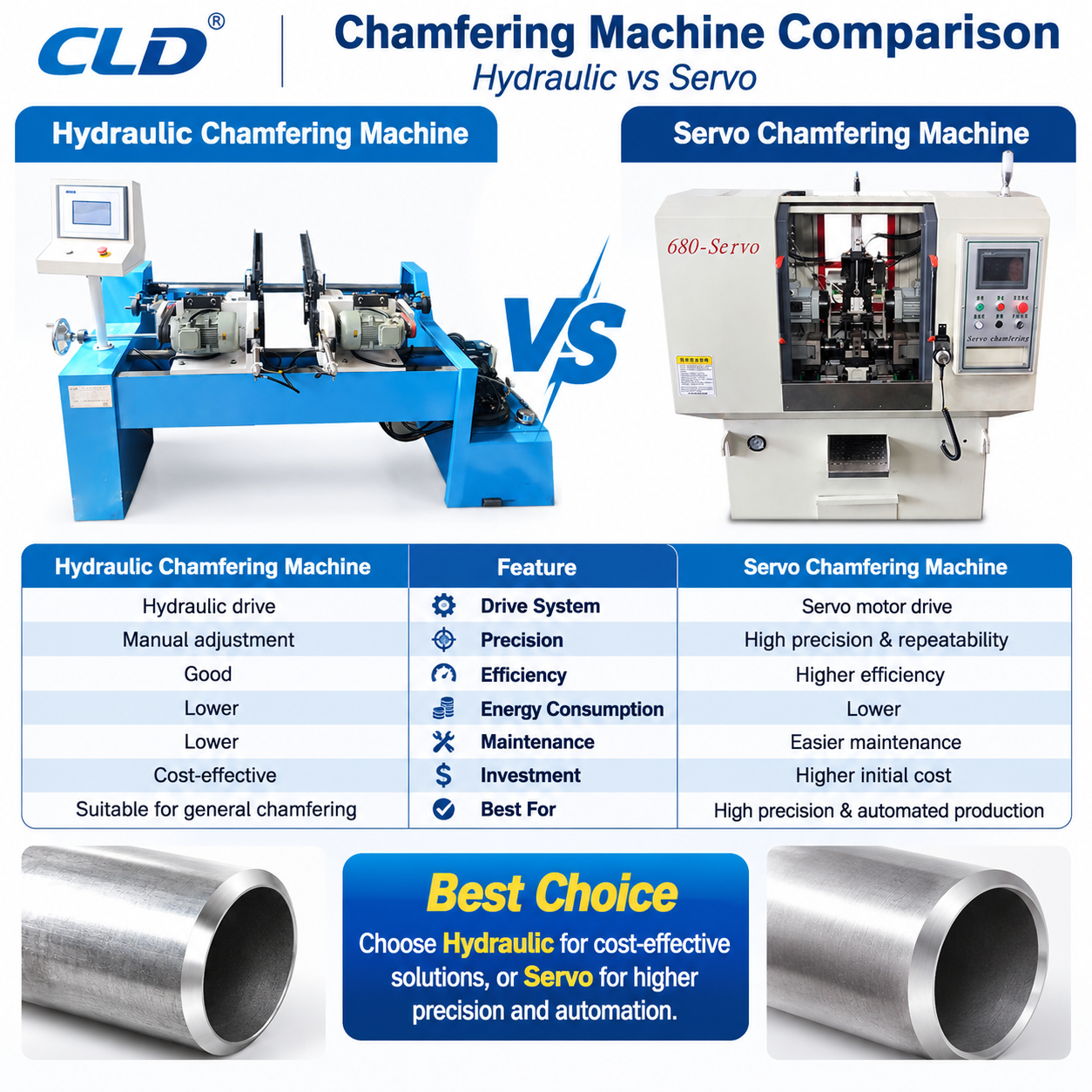

Author: Jiangsu Clayton Machinery Co., Ltd.
Keyword: double head chamfering machine, servo chamfering machine, hydraulic chamfering machine, tube end machining
Introduction
Double head chamfering machines are widely used for end facing, inner and outer chamfering of round tubes, solid bars and shaft workpieces in pipe processing, automotive fittings, hardware and scaffolding industries. Two mainstream driving types are servo CNC double head chamfering machine and hydraulic double head chamfering machine. Many purchasers struggle to select suitable models according to production batch, tolerance requirement and long-term operation cost. This article compares them from efficiency, machining accuracy, procurement cost and running cost, to help users make reasonable equipment selection.
1. Machining Accuracy
Servo double head chamfering machine adopts servo motor + ball screw for feeding on both heads. The two spindles are controlled synchronously by CNC program. The feeding stroke, chamfer depth and retraction position can be set digitally with closed-loop position feedback.
- Repeat positioning accuracy: ±0.02 mm
- Chamfer consistency on both ends: stable, less difference between left and right chamfer size
- Angle and depth adjustment: input parameter directly on touch screen, no manual mechanical fine-tuning
- Suitable for: stainless steel pipe, precision shaft, hydraulic fittings, workpieces with strict tolerance requirements
Hydraulic double head chamfering machine uses hydraulic cylinder to drive feeding. The feeding speed and stroke rely on flow control valve and travel limit switch. Hydraulic oil pressure fluctuation, oil temperature change and cylinder sealing wear will affect feeding stability.
- Repeat positioning accuracy: ±0.05~±0.10 mm
- Chamfer size deviation: easy to appear uneven chamfer on two ends when oil temperature rises or pressure changes
- Adjustment: need manual adjustment of limit blocks and flow valves, relying on operator experience
- Suitable for: ordinary carbon steel pipe, low-precision scaffolding pipe, rough end chamfering
2. Production Efficiency
For short-cycle mass production, the efficiency gap is reflected in feeding response, retraction speed, changeover time and stability under continuous running. Servo double head chamfering machine:
- Feeding and retraction speed are independently adjustable, fast response without pressure build-up delay
- Multi-set processing recipes can be stored. When changing workpiece specifications, call the recipe directly on HMI
- Stable cycle time for long continuous running, no speed drift caused by oil temperature
- High efficiency for frequent product changeover and mixed batch production
Hydraulic double head chamfering machine:
- The hydraulic system needs pressure buildup; feeding speed is limited by oil flow. Cycle time will become longer when oil heats up
- Specification change requires repeated mechanical adjustment of stoppers and flow valves, long changeover time
- For fixed single-specification mass production, it can reach acceptable efficiency, but consistency drops after hours of continuous working
3. Cost Analysis
3.1 Initial Procurement Cost
Servo double head chamfering machine: Higher purchase cost. It is equipped with servo motors, servo drives, precision ball screws, CNC controller and high-resolution encoder. The core electrical components increase the machine investment.
Hydraulic double head chamfering machine: Lower upfront cost. It uses hydraulic station, oil cylinder and simple relay or PLC control, simpler transmission structure, lower machine price.
3.2 Operating & Maintenance Cost
Servo type:
- No hydraulic oil, no oil leakage trouble
- Main wearing parts: linear guide, ball screw, tool holder and blades
- Low daily maintenance; only regular lubrication for guide rail and screw
- Power consumption is relatively low, servo motor runs only during feeding action
Hydraulic type:
- Need regular replacement of hydraulic oil, oil filter and sealing rings
- Common faults: oil leakage, oil pump noise, seal aging, valve block jam
- High power consumption: hydraulic pump keeps running to maintain pressure even in standby status
- Maintenance labor cost is higher in long-term operation
4. Advantages and Disadvantages Summary
Servo Double Head Chamfering Machine
✅ Advantages: High precision, stable chamfer consistency, fast recipe switching, clean without oil leakage, low long-term maintenance cost, flexible for multi-specification production ❌ Disadvantages: Higher initial investment, higher requirement for electrical debugging
Hydraulic Double Head Chamfering Machine
✅ Advantages: Low purchase price, strong clamping thrust, simple mechanical structure, easy for basic operation ❌ Disadvantages: Accuracy affected by oil temperature and pressure, oil leakage risk, long changeover time, higher running and maintenance cost, unstable cycle time for continuous production
5. Selection Suggestion
Choose servo double head chamfering machine if your products are stainless steel, alloy pipe, precision shaft parts with strict dimensional tolerance, or you often switch different workpiece sizes. It brings stable quality and reduces rejection rate.
Choose hydraulic double head chamfering machine if you only process ordinary carbon steel pipes with fixed specification, low precision requirement, and you have limited budget for initial equipment investment.
Conclusion
Servo double head chamfering machine is the preferred solution for high-end precision pipe end machining, featured by digital control and stable accuracy. Hydraulic chamfering machine is a cost-effective option for low-precision, single-variety mass processing. Enterprises should balance precision demand, production flexibility and total life cycle cost instead of only focusing on the machine’s purchase price.


Leave a Reply