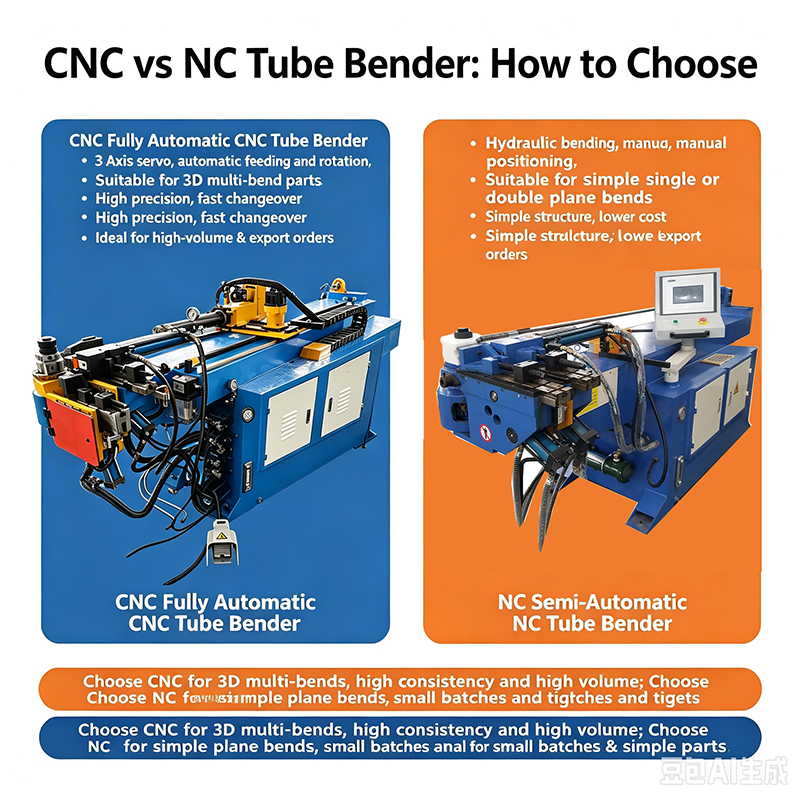

Selecting Between NC and CNC Tube Bending Machines
CNC Tube Bending Machines
Summary: For simple 2D single/double bends, small batches, or tight budgets → NC; for complex 3D multi-bend parts, frequent product changeovers, high-volume production, or export parts requiring high consistency → CNC.
I. Core Definitions
NC (Semi-automatic Tube Bending Machine)
Hydraulic-driven bending; manual positioning required for feeding length and tube rotation (B-axis rotation angle). Limited to 2D parts (1–2 bends within the same plane); simple programming; incapable of producing 3D parts with multi-angle bends.
Advantages: Low cost, simple structure, easy maintenance, quick learning curve.
Disadvantages: High level of manual involvement; consistency depends on operator skill; slow setup/adjustment for specification changes; cannot produce complex 3D multi-bend parts; moderate precision (angular error of ±0.5°–1°).
Applications: Guardrails, simple U-shaped parts, single-bend components; suitable for small batches, diverse orders, and domestic market products where strict consistency is not required.
CNC (Fully Automatic CNC Tube Bending Machine, e.g., DW38CNC / DW75CNC)
3-axis/multi-axis servo control: Servo-driven feeding (Y-axis), servo-driven rotation (B-axis), and hydraulic bending (C-axis). Input XYZ coordinates or YBC bending parameters via computer; the entire tube is processed automatically in one cycle, handling multiple bends and spatial rotations. Supports complex 3D parts (seat frames, vehicle chassis, fitness equipment); stores hundreds of program recipes, allowing for instant recall when switching products. Advantages: High repeatability (±0.1°) and consistent performance; saves labor and allows for quick changeovers; capable of complex 3D multi-angle bending (ideal for export orders); compatible with mandrels for bending thin-walled tubes with small bend radii (small R).
Disadvantages: Higher initial equipment cost; requires personnel training in programming; higher maintenance requirements for servo and electronic control systems.
Applications: Chair frames, vehicle frames, construction machinery piping, export orders; suitable for both high-volume production of a single specification and frequent changeovers across multiple product types.
III. Selection Checklist (Compare directly against your orders)
✅ Choose NC if all the following apply:
Bends are strictly planar (2D); maximum of 1–2 bends per tube; no spatial twisting or rotation required.
Small-batch, multi-specification orders; priority is minimizing equipment investment.
Loose dimensional tolerances; no strict requirements for go/no-go gauge testing or rigorous export quality inspections.
Thick-walled tubes with large bend radii (large R); no need for mandrels to bend thin-walled, small-diameter tubes.
✅ Choose CNC if any of the following apply:
3D/spatial tube structures (e.g., chair frames, vehicle frames; bends lie in different planes, requiring tube rotation).
Export orders (VK or international clients) requiring high dimensional consistency to minimize customer complaints.
High-volume production of a single specification, or frequent product changeovers based on diverse customer samples.
Thin-walled tubes with small bend radii (R/D ≤ 2.5); requires mandrel bending and strict control over ovality and wall thinning.
Goal to reduce labor and minimize scrap rates caused by human error.
 English
  Bahasa Indonesia
  한국어
한국어  Português do Brasil
  Polski
  Русский
  Español de México
  ไทย
ไทย  Tiếng Việt
Tinggalkan Balasan