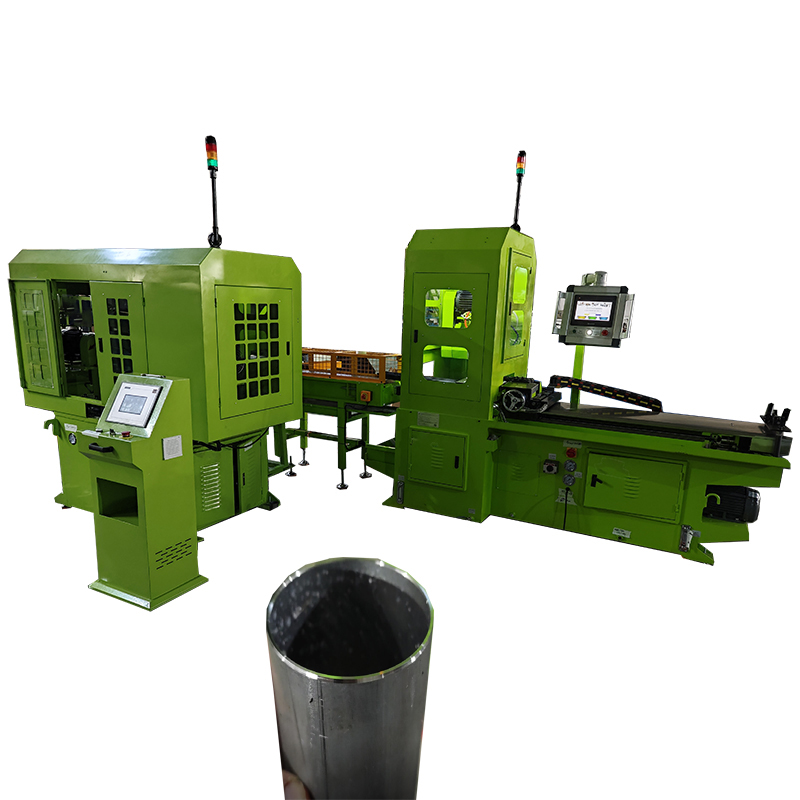


1. Solution Overview(Jiangsu Clayton Team Proposal)
This inline production line integrates the MC425CNC fully automatic CNC cold saw and a servo-driven double-head chamfering machine via a precision transition conveying system, realizing fully automatic continuous production from raw pipe loading, fixed-length cutting, both-end chamfering to finished product collection. It eliminates manual intermediate handling, balances cutting and chamfering cycle time, and delivers consistent batch quality.
Compared with standalone machine operation, this integrated line reduces labor input by 60% and improves overall processing efficiency by 2–3 times, making it an ideal automated solution for high-volume metal pipe fabrication workshops.
2. Line Configuration & Equipment Composition
2.1 Automatic Loading Rack
- Stores raw pipe bundles (6m standard length), supports automatic single-piece feeding
- Compatible with round pipe, square pipe, rectangular pipe and common profiles
- Equipped with material shortage alarm and automatic feeding logic
2.2 MC425CNC Fully Automatic CNC Pipe Cutting Machine
- Core cutting station with servo feeding system, positioning accuracy ±0.1mm
- Hydraulic cold cutting technology, no heat-affected zone (HAZ) and minimal burr on cut ends
- Built-in hydraulic tail-saving mechanism, tail material length controlled within 10–20mm
- Supports multi-length batch programming and automatic production counting
2.3 Transition Conveyor & Positioning Unit
- Smoothly transfers cut pipes from cutting station to chamfering station
- Equipped with end alignment and positioning mechanism to ensure accurate feeding into chamfering spindles
- Speed synchronized with both upstream cutting and downstream chamfering cycles
2.4 Double-Head Servo Chamfering Machine
- Simultaneously processes both pipe ends in one pass, including outer chamfer, inner chamfer and end face facing
- Servo-controlled feed, adjustable chamfer angle (15°–45°) and depth
- Self-centering clamping structure, ensures concentricity and uniform chamfer quality
- Compatible with carbon steel, stainless steel, aluminum and copper pipes
2.5 Finished Product Unloading Rack
- Automatically collects processed pipes and stacks them in order
- Supports production counting and full-material alarm
- Optional sorting function for different length specifications
2.6 Centralized Control System
- Unified HMI for parameter setting of the whole line: cutting length, quantity, chamfer size
- Real-time status monitoring, fault diagnosis and alarm display
- One-click recipe saving for quick switch between different product specifications
3. Automatic Working Cycle
- The operator stacks raw pipes on the loading rack, inputs cutting length, production quantity and chamfer parameters on the central touch screen.
- The loading mechanism automatically feeds a single pipe into the MC425CNC feeding channel.
- The MC425CNC performs servo fixed-length feeding and hydraulic cold cutting, producing pipes with consistent length and smooth cut ends.
- Cut pipes are discharged onto the transition conveyor, which aligns the pipe ends and feeds them into the double-head chamfering station.
- The chamfering machine clamps the pipe and machines both ends simultaneously, completing outer chamfer, inner chamfer and flat face finishing in one cycle.
- Finished pipes are automatically pushed to the unloading rack, with real-time production counting.
- The line stops automatically when the set quantity is reached or raw material runs out.
4. Core Technical Advantages
- Unattended continuous production: One operator can manage 2–3 lines, greatly reducing labor cost and handling errors caused by manual transfer.
- Stable and consistent quality: Unified length control and standardized chamfering process ensure interchangeability of mass-produced parts, suitable for subsequent automatic bending and welding processes.
- High material utilization: The tail-saving structure of MC425CNC minimizes leftover material, and the positioning system reduces scrap caused by misaligned chamfering.
- Cold cutting process: No thermal deformation or oxidation layer on cut surfaces, low burr, preserves original material mechanical properties.
- Compact layout: Integrated inline design reduces intermediate storage space and workshop footprint.
- Comprehensive safety protection: Fully enclosed guards and safety interlocks on all stations avoid manual contact with moving parts and cutting tools.
5. Main Technical Specifications
表格
| Item | Specification |
|---|---|
| Cutting Station (MC425CNC) | |
| Max. round pipe cutting diameter | Φ120 mm |
| Max. square pipe cutting size | 120 × 120 mm |
| Max. wall thickness | 8–10 mm (material dependent) |
| Feeding accuracy | ±0.1 mm |
| Standard saw blade diameter | 425 mm |
| Chamfering Station | |
| Chamfering diameter range | Φ10 – 120 mm |
| Chamfer type | Outer chamfer / inner chamfer / end face facing |
| Chamfer angle | 15° – 45° (adjustable) |
| Clamping mode | Self-centering hydraulic / pneumatic |
| General Line Parameters | |
| Standard raw pipe length | 6000 mm |
| Control system | PLC + centralized touch screen HMI |
| Cooling method | Circulating wet cooling |
| Power supply | 380V / 50Hz / 3-phase (customizable) |
| Typical line dimension (L×W×H) | Approx. 8500 × 1800 × 2000 mm |
6. Applicable Industries & Typical Workpieces
This line is widely used for mass production of pipe parts in the following industries:
- Motorcycle & automotive components: exhaust pipes, seat frames, bumper tubes
- Steel furniture: table and chair frames, wardrobe support tubes
- Fitness equipment: gym rack tubes, treadmill frame parts
- Construction & guardrail: stair handrails, balcony guardrails, scaffolding tubes
- Solar mounting brackets: square and rectangular support tubes
- Sanitary hardware: towel racks, shower support pipes
7. Optional Custom Configurations
- Automatic bundle loading system for higher volume production
- Chip collection and filtration system
- Multi-language control interface (English, Spanish, Polish, etc.)
- Custom voltage and frequency adaptation
- Laser marking / inkjet coding unit for product traceability
- Length sorting and automatic packing module
FAQ – MC425CNC Pipe Cutting + Double-Head Chamfering Integrated Line
- Q: What types of workpieces and materials is this integrated cutting and chamfering line suitable for? A: This line is compatible with round pipes, square pipes, rectangular pipes and common metal profiles. It processes a wide range of materials including carbon steel, stainless steel, aluminum, copper and alloy steel, and is widely used for mass production of standard pipe parts.
- Q: How much does production efficiency improve compared with standalone machines? A: Compared with separate standalone cutting and chamfering machines, this inline solution eliminates manual transfer and waiting time between processes. It increases overall processing efficiency by 2–3 times and reduces labor input by about 60%. For standard carbon steel pipes, it can typically complete 300–600 finished pieces per shift depending on pipe size and length.
- Q: What is the processing accuracy of the whole line? A: Driven by a servo feeding system, the MC425CNC cutting station delivers a length positioning accuracy of ±0.1mm. The chamfering station adopts a self-centering clamping structure, ensuring uniform chamfer size and good concentricity. The finished pipe ends are flat and burr-free, fully meeting the requirements of subsequent bending and automatic welding.
- Q: How long does it take to change over to a different pipe specification? A: For conventional size changes, operators only need to replace clamping jaws and call the saved production recipe on the touch screen. The whole changeover process takes about 10–15 minutes. The control system supports storage of multiple process recipes for fast product switching.
- Q: How many operators are needed to run this production line? A: Only one operator is required for daily operation. The worker only needs to load raw pipe bundles onto the loading rack, set parameters on the central HMI, and monitor the running status. The whole line runs automatically from cutting to chamfering and finished product collection.
- Q: How is the leftover tail material handled? Will short tail pieces enter the chamfering station? A: The MC425CNC is equipped with a hydraulic tail-saving mechanism that controls tail material length within 10–20mm. The transition conveyor is designed with an automatic sorting function to identify and discharge unqualified short tail pieces, preventing them from entering the chamfering station and ensuring finished product yield.
- Q: What routine maintenance work is required? A: Daily maintenance includes checking coolant level, cleaning metal chips, and lubricating guide rails and transmission parts. Periodic maintenance covers inspecting saw blade sharpness, chamfering tool wear, and hydraulic system pressure. The main consumable parts are HSS / TCT saw blades and chamfering cutter heads.
- Q: What is the footprint of the standard production line? A: For a standard configuration with 6-meter raw pipe capacity, the overall line dimension is approximately 8500 mm (length) × 1800 mm (width) × 2000 mm (height). The layout can be adjusted according to your workshop space and production flow.
- Q: Can we upgrade our existing MC425CNC cutting machine with this chamfering line? A: Yes, we provide retrofit solutions for existing MC425CNC machines. We supply the transition conveyor unit, double-head chamfering machine and matching control system to connect with your current equipment, which greatly reduces your upgrade investment compared with purchasing a complete new line.
- Q: What optional configurations can be added to the line? A: Common optional upgrades include automatic bundle loading system, laser marking / inkjet coding unit, length sorting module, chip filtration and collection system, multi-language control interface, and customized voltage / frequency adaptation to meet different production and regional requirements.


Leave a Reply