1. Introduction
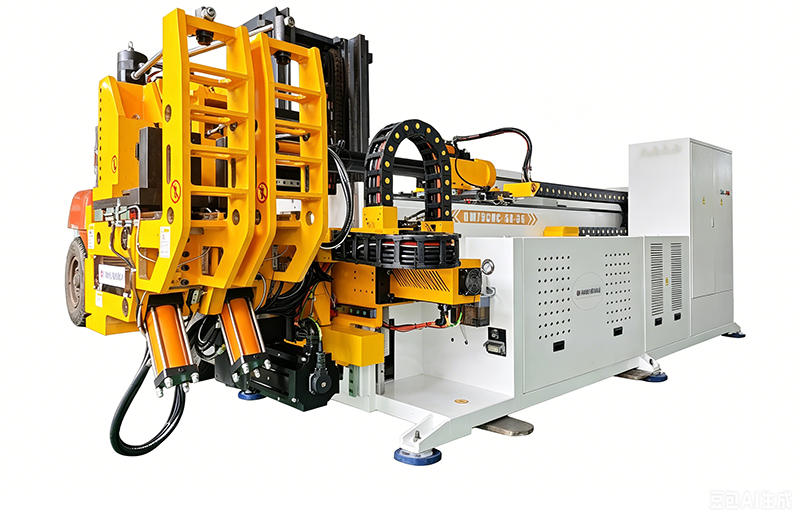
Automotive exhaust systems require smooth, consistent, and structurally precise bent tubes to ensure stable airflow, low noise, and long service life. Traditional manual bending and semi-automatic processing often cause pipe wrinkling, flattening, cracking, and inconsistent bending angles, which greatly affect exhaust performance and assembly accuracy. With the upgrading of automobile manufacturing and performance exhaust modification, fully automatic CNC tube bending machines have become the standard equipment for mass production of stainless steel exhaust pipes, muffler tubes, tailpipes, and catalytic converter connecting pipes. This article explains the standard industrial process, parameter settings, tooling configuration, and quality control methods for bending automotive exhaust pipes with automatic CNC benders.
2. Why CNC Automatic Bending Is Ideal for Automotive Exhaust Tubes
Automotive exhaust pipes are mostly thin-wall stainless steel (SS304/SS316) with complex 3D multi-bend layouts. Fully automatic servo CNC benders outperform traditional equipment in the following aspects:
- High precision repeatability: Controlled by multi-axis servo system, bending tolerance is stable within ±0.1 mm and ±0.1°, ensuring identical dimensions for each batch of exhaust pipes.
- Mandrel anti-deformation technology: Built-in mandrel and anti-wrinkle die effectively prevent tube flattening and inner wall wrinkling during thin-wall pipe bending.
- One-time multi-bend forming: Supports automatic feeding, rotating, and continuous 3D bending in one clamping, avoiding cumulative positioning errors.
- Programmable mass production: Stores hundreds of vehicle exhaust programs for fast switching between different car models and modified pipe shapes.
3. Pre-Production Preparation & Tooling Setup
Stable exhaust pipe bending quality depends on standardized pre-setup before production.
3.1 Material Confirmation
Confirm pipe outer diameter, wall thickness, and material hardness. Common automotive exhaust materials include SS304, SS316 stainless steel, and thin-wall carbon steel. Stainless steel pipes produce obvious springback, which requires reserved angle compensation.
3.2 Tooling Matching
Install matched bend die, clamp die, pressure die, and mandrel according to pipe size:
- Thin-wall exhaust pipes must use flexible mandrels to support the inner wall and maintain roundness during bending.
- Install anti-wrinkle plates to eliminate inner tube folds on tight-radius bends.
- Adjust clamping pressure to avoid surface scratching while preventing pipe sliding.
3.3 Machine Inspection
Check hydraulic pressure, servo origin position, safety sensors, and lubrication system to ensure stable operation during continuous automatic cycles.
4. CNC Programming & Core Parameter Setting
All exhaust pipe bending shapes are realized through CNC parameter programming. Operators input geometric and technological parameters via the HMI touch screen.
4.1 Geometric Parameters
Input straight length (L value), bending angle (A value), and spatial rotation angle (R value) according to the exhaust pipe 3D drawing. Multi-section combined bends are edited sequentially to form a complete 3D tube trajectory.
4.2 Technological Parameters
- Bending speed: 20–45°/s for thin-wall stainless steel to avoid cracking;
- Springback compensation: Add 3–8° compensation for stainless steel pipes according to wall thickness;
- Feeding and rotating speed: Keep uniform and stable to avoid trajectory deviation;
- Clamping holding time: Ensure no displacement during bending.
4.3 Dry Run Simulation
After saving the program, perform an empty run to verify the bending path and avoid mechanical collision before formal production.
5. Fully Automatic Bending Operation Process
Step 1: Automatic Feeding and Positioning
Place the raw exhaust pipe on the feeding rack. The servo feeding system automatically pushes the pipe to the first bending station with precise length positioning.
Step 2: Clamping and Forming
The hydraulic clamp locks the tube tightly. The bending arm rotates according to the programmed angle, while the mandrel supports the inner wall to ensure smooth forming without deformation.
Step 3: Multi-Angle 3D Continuous Bending
After completing one bend, the machine automatically rotates the pipe to the required spatial angle and proceeds to the next bend. The whole complex exhaust tube shape is finished in one clamping cycle without manual repositioning.
Step 4: Automatic Unloading and Sampling Inspection
Once all bending processes are completed, the equipment automatically releases and unloads the finished pipe. Workers check bending accuracy, roundness, surface smoothness, and whether there are wrinkles or cracks.
6. Common Defects & Solutions for Exhaust Pipe Bending
| Defect | Causes | 솔루션 |
|---|---|---|
| Inner wall wrinkling | Insufficient clamping force, no anti-wrinkle plate, fast bending speed | Increase clamping pressure, install anti-wrinkle tooling, reduce bending speed |
| Pipe cracking | Excessive stretching, insufficient springback compensation | Optimize bending radius, increase angle compensation, slow down forming speed |
| Tube flattening (oval deformation) | No mandrel support or mismatched mandrel size | Install matched inner mandrel to support tube wall |
| Unstable bending angle | Servo deviation, worn dies, pressure fluctuation | Calibrate servo origin, replace worn tooling, stabilize hydraulic pressure |
7. Advantages of Automatic CNC Bending for Exhaust Manufacturing
- High yield rate: Effectively solves thin-wall stainless steel bending defects, greatly reducing scrap loss.
- Mass production stability: Consistent batch accuracy meets OEM factory assembly standards.
- Strong compatibility: Suitable for standard factory exhaust pipes and customized performance modified exhaust systems.
- Labor-saving & high efficiency: Realizes automatic cycle production, improving efficiency by more than 60% compared with semi-automatic machines.
8. Conclusion
Fully automatic CNC tube bending machines have become the mainstream processing solution for modern automotive exhaust pipe manufacturing. Through standardized tooling matching, precise CNC parameter setting, mandrel-assisted forming, and automatic cycle operation, manufacturers can achieve high-precision, zero-wrinkle, high-consistency exhaust pipe production. With the growing demand for high-performance automobiles and customized exhaust modification, automated CNC bending technology will continue to be the core production process for the global auto parts industry.
 English
  Bahasa Indonesia
  한국어
한국어  Português do Brasil
  Polski
  Русский
  Español de México
  ไทย
ไทย  Tiếng Việt
댓글 남기기