

1. Introduction
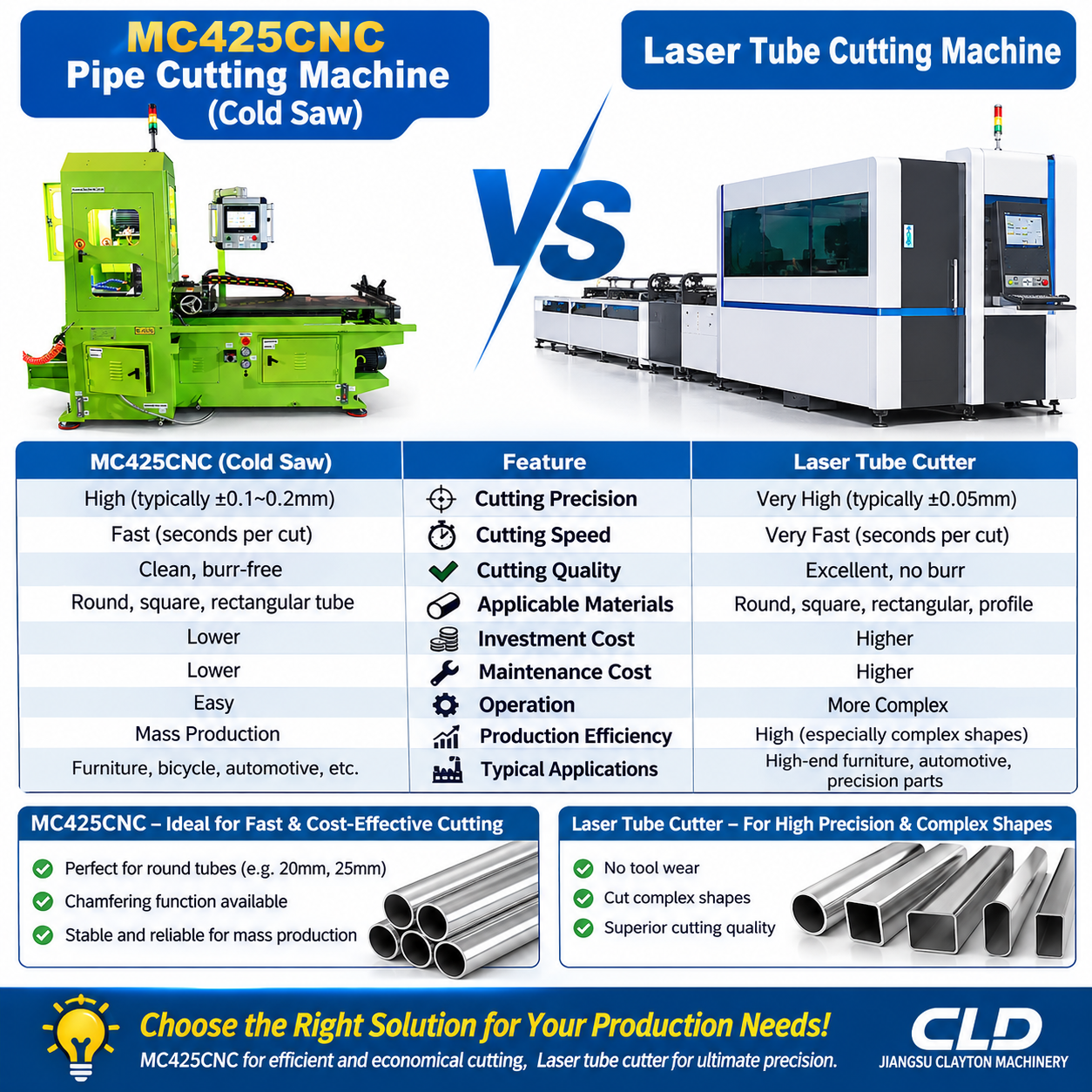
In metal tube fabrication, the MC425CNC automatic cold saw and the fiber laser tube cutting machine represent two mainstream cutting technologies with distinct technical routes. The MC425CNC performs mechanical shearing via a rotating carbide-tipped circular blade, delivering stable performance for mass production of straight cut-to-length parts. The fiber laser cutter uses a focused high-energy beam to melt and remove material, enabling flexible, high-precision machining of complex contours.
This article provides a systematic technical comparison between the two solutions, covering working principles, applicable scenarios, cutting efficiency and total cost of ownership, to help manufacturers select the optimal equipment for their production characteristics.
2. Core Working Principle & Basic Capabilities
2.1 MC425CNC Cold Saw Tube Cutting Machine
The MC425CNC is a fully automatic CNC cold saw adopting electric-hydraulic drive and servo feeding system. It uses a 425 mm diameter carbide circular saw blade rotating at low speed to perform mechanical shear cutting, accompanied by coolant lubrication to control cutting heat.
Key specifications of MC425CNCfr.Made-in…:
- Max. cutting capacity: Ø120 × 5 mm for round tubes; also compatible with square, rectangular and profile tubes
- Feeding accuracy: ±0.1 mm
- Capable of batch cutting, the MC425CNC can cut up to 27piece 1 inch pipes in a single operation.
- Max. single feeding length: 1500 mm (customizable for longer lengths)
- Control system: Mitsubishi PLC with touch screen interface
- Blade drive: Full gear transmission for stable torque output
- Special capability: Multi-tube simultaneous cutting for small-diameter tubes, greatly improving throughput
2.2 Fiber Laser Tube Cutting Machine
Fiber laser tube cutting is a non-contact thermal processing technology. A high-power laser beam is focused on the tube surface, instantly melting or vaporizing the metal, while assist gas (oxygen, nitrogen or compressed air) blows away molten slag. Equipped with a rotary chuck and multi-axis CNC system, it can cut straight lines, bevels, holes, slots, copes and arbitrary contours in one clamping.
Typical configurations range from 1.5 kW to 6 kW for standard tube processing, with positioning accuracy generally within ±0.03–0.05 mm.
3. Application Scenario Comparison
3.1 Scenarios Where MC425CNC Cold Saw Performs Better
- High-volume straight cut-to-length production For furniture tubes, shelf tubes, construction scaffolding and structural pipe parts that only require fixed-length 90° cutting, the MC425CNC achieves extremely low cost per cut. Its stable mechanical cutting rhythm is highly suitable for 24-hour continuous mass production with single-specification batches.
- Thick-wall and high-strength alloy tubes When processing thick-wall carbon steel, stainless steel or alloy steel tubes, the cold saw maintains consistent cutting speed and edge quality by mechanical force. In contrast, laser cutting requires significantly higher power and slower feed speed for thick walls, leading to sharply increased cost and heat-affected zone risk.
- Multi-tube simultaneous processing For small-diameter tubes (e.g., Ø10–Ø25 mm), the MC425CNC can clamp and cut multiple tubes in one stroke, which is a major efficiency advantage for large-batch small-tube production that laser machines cannot easily match due to single-tube processing logic.
- Production workshops with limited technical capacity Cold saws have a simple mechanical structure. Operators can be trained within hours, and routine maintenance (blade replacement, lubrication) can be completed by in-house technicians without specialized laser optical knowledge.
3.2 Scenarios Where Fiber Laser Tube Cutter Has Irreplaceable Advantages
- Complex contour and multi-process integrated cutting Laser machines can complete hole drilling, slotting, notching, cope cutting, angle cutting and graphic engraving in one clamping. For products such as fitness equipment frames, automotive pipe fittings and furniture decorative tubes that require multiple processes, laser eliminates multiple machining steps and secondary clamping errors.
- Thin-wall precision tubes For thin-wall stainless steel tubes, aluminum tubes and copper tubes below 2 mm wall thickness, non-contact laser cutting avoids clamping deformation and tube collapse caused by mechanical sawing. The narrow kerf (<0.2 mm) also minimizes material waste.
- Multi-variety, small-batch flexible production When production involves frequent size changes and mixed batches, the laser system can switch programs in seconds without changing tooling. This makes it ideal for custom fabrication shops, engineering projects and sample development.
- High-end products with strict surface quality Laser cutting produces a near-burr-free smooth cut surface with minimal heat-affected zone, eliminating or reducing deburring and chamfering processes. This is critical for medical devices, food equipment and high-end furniture components.
4. Cutting Efficiency Comparison
4.1 Straight 90° Cutting Speed
For simple fixed-length 90° cutting, the efficiency comparison depends on tube size and batch size:
- Small-diameter thin-wall tubes (≤Ø38 mm): The MC425CNC can cut multiple tubes simultaneously, achieving 40–60 cuts per minute. A standard laser machine cuts one tube at a time at 60–120 cuts per minute, giving it a speed advantage per single tube but lower throughput for multi-tube scenarios.
- Medium to large tubes (Ø50–Ø130 mm): The MC425CNC maintains a stable 20–35 cuts per minute regardless of wall thickness within its capacity. Laser cutting speed decreases noticeably as wall thickness increases; for 4–5 mm thick tubes, speed drops to levels comparable to or slower than the cold saw.
- Batch consistency: The cold saw has a fixed mechanical cycle with very stable tact time. Laser speed fluctuates more with material, thickness and cutting pattern complexity.
4.2 Changeover & Setup Efficiency
- MC425CNC: Changing tube size requires adjusting clamping fixtures and blade parameters, typically taking 5–15 minutes. Changing cutting length only requires numerical input on the touch screen.
- Laser tube cutter: Switching between different lengths, angles or even completely different part drawings takes only a few seconds via program call. No mechanical tooling change is needed for tube size changes within the chuck range.
4.3 Integrated Process Efficiency
For parts requiring holes, slots or multiple angle cuts:
- The MC425CNC only completes cutting to length; subsequent drilling, milling and deburring require additional equipment and labor, extending total process time.
- The laser machine completes all contour features in one clamping, greatly shortening the total production cycle for complex parts despite higher per-cut cost.
5. Cost Performance & Total Ownership Cost
5.1 Initial Investment
- MC425CNC cold saw: The equipment price is typically 1/4 to 1/3 of an entry-level fiber laser tube cutter of comparable capacity. It does not require auxiliary systems such as chillers, gas storage tanks or dust collectors on the same scale, resulting in much lower installation and civil engineering costs.
- Fiber laser tube cutter: The main machine, laser source, chiller, dust removal system and gas supply system constitute a high initial investment. Higher power models and automatic loading/unloading lines further increase capital expenditure.
5.2 Operating & Consumable Costs
表格
| Cost Item | MC425CNC Cold Saw | Fiber Laser Tube Cutter |
|---|---|---|
| Main consumable | Carbide saw blade (can be resharpened 3–5 times) | Protective lens, nozzle, laser source life attenuation |
| Consumable cost per hour | Low; blade cost amortized over thousands of cuts | High; lens replacement, gas consumption and power cost are significant |
| Power consumption | 4–5 kW total | 10–25 kW depending on laser power |
| Assist gas | None (coolant only, low consumption) | Continuous oxygen/nitrogen/air consumption |
| Maintenance complexity | Simple; in-house team can handle | Requires professional optical and electrical maintenance |
For pure straight cut-to-length production, the cost per cut of the MC425CNC is 50–70% lower than that of a laser machine, and the advantage widens as production volume increases.
5.3 Post-processing Cost
- MC425CNC: Produces minimal burrs for standard applications, but high-precision or high-end products still require deburring and chamfering processes, adding labor and equipment cost.
- Laser tube cutter: Cut edges are essentially burr-free. For many applications, parts can go directly to bending, welding or assembly, saving secondary processing cost.
5.4 Return on Investment Perspective
- The MC425CNC has a short payback period for factories focused on large-batch simple tube cutting. Its low operation and maintenance cost makes it a robust profit center for standard products.
- The laser tube cutter delivers higher value when products have added value from complex shapes, reduced labor and shortened delivery time. It is more suitable for factories upgrading to high-margin, diversified production.
6. Summary of Advantages and Disadvantages
表格
| Dimension | MC425CNC Cold Saw | Fiber Laser Tube Cutter |
|---|---|---|
| Cutting capability | Straight cut and simple angle cut only | Straight cut, bevel, hole, slot, arbitrary contour |
| Cutting speed (straight cut) | High, especially with multi-tube cutting | High for thin walls, decreases with thickness |
| Thick-wall performance | Excellent, stable speed and quality | Requires high power, cost increases sharply |
| Cutting precision | ±0.1 mm length tolerance | ±0.02–0.05 mm, higher contour accuracy |
| Edge quality | Low burr, may need deburring | Near burr-free, minimal heat-affected zone |
| Flexibility | Low, dedicated to straight cutting | High, program-based flexible processing |
| Initial investment | Low | High |
| Operating cost per cut | Very low for straight cutting | Higher for simple cuts, competitive for complex parts |
| Maintenance difficulty | Low, easy to master | Requires specialized technical personnel |
| Best fit | Mass production of standard-length structural tubes | Multi-variety, complex contour, high-precision parts |
7. Selection Recommendations
- Choose MC425CNC if:
- Your main production is fixed-length 90° cutting of round, square or rectangular tubes in large batches
- You frequently process thick-wall or high-strength metal tubes
- You prioritize low operating cost and simple maintenance
- Multi-tube simultaneous cutting can significantly boost your output
- Choose fiber laser tube cutter if:
- Your products require holes, slots, notches or other complex contours
- You have frequent product changes and need fast flexible production
- End products demand burr-free high-quality cut surfaces
- You aim to integrate multiple processes and reduce overall labor and machining steps
For many growing fabrication shops, a combined configuration — MC425CNC for bulk standard cutting plus a laser machine for complex and high-value orders — often delivers the optimal balance of efficiency, cost and product capability.


Leave a Reply