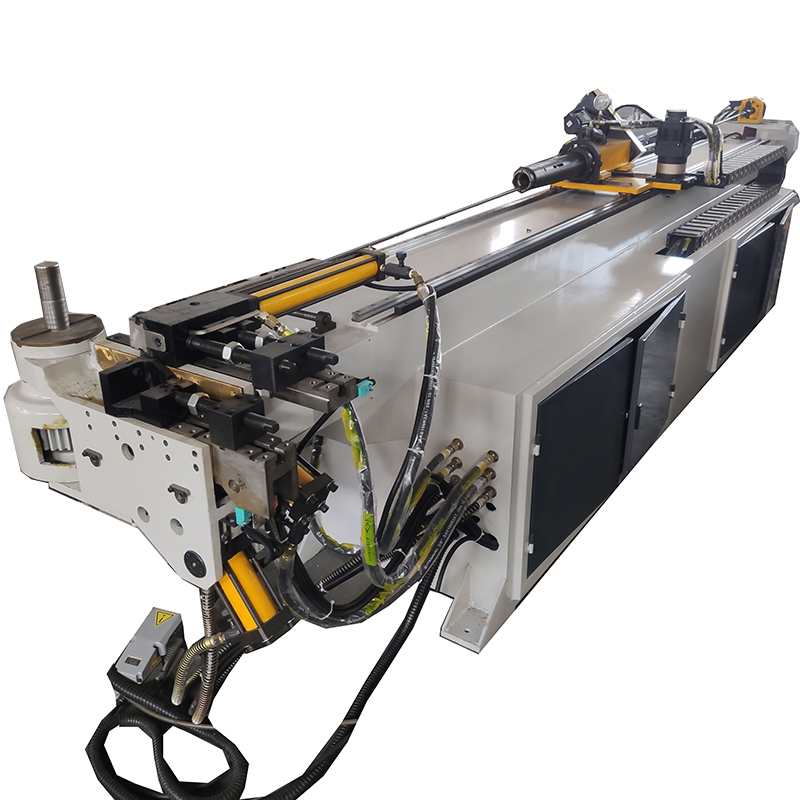
Square tubing (square hollow section, SHS) is widely used for handrails, furniture frames, guardrails, agricultural machinery and metal structural parts. Compared with round tubes, square tubing features flat sides and sharp corners, which makes it much easier to produce cross-section distortion, inner wrinkling, outer wall cracking and flattening during bending. Only with standardized operation, matched tooling and reasonable parameter setting can manufacturers obtain smooth, dimension-qualified bent workpieces. This guide mainly focuses on rotary draw cold bending by CNC hydraulic square tube bending machine.
1. Main Bending Methods for Square Tubing

- CNC Rotary Draw Mandrel Bending (Recommended for Mass Production) The mainstream process for industrial fabrication. Equipped with segmented mandrel inside the tube to support the inner wall, effectively avoiding tube collapse. Suitable for stainless steel, carbon steel and aluminum square tubes, applicable for thin-wall tubing and small centerline radius bends. Our DW38CNC series CNC square tube bender adopts this technology.
- Roll Bending Fit for large-radius gentle curves; not suitable for sharp-angle bends. High risk of section flattening for thin-wall square tubes.
- Kerf & Weld Bending (Manual Workshop Only) Cut V notches on one side of square tube, bend and weld the gap. This method destroys integral structural strength, not recommended for load-bearing components.
2. Step-by-Step Operating Procedures for CNC Square Tube Bending
Step 1: Pre-job Preparation
- Confirm square tube specifications: outer size, wall thickness, material grade (mild steel, stainless steel, aluminum). Verify material ductility; brittle high-carbon steel is prone to cracking.
- Select matched bending dies, clamp dies, pressure dies and segmented mandrel. Never use round tube dies for square tubing.
- Clean oil, rust and burrs on tube surface. Apply specialized lubricant between mandrel and tube inner wall to reduce friction.
Step 2: Machine & Tooling Installation

- Install tooling strictly matching square tube outer dimension; ensure all die grooves are aligned on the same horizontal centerline. Misalignment directly causes tube twisting.
- Adjust mandrel position: the front end of the segmented mandrel should extend slightly past the bending tangent point to support the bending zone.
- Set clamping force properly: enough to prevent tube slipping, avoid excessive pressure leaving heavy indentations on tube surface.
Step 3: Program Debugging & Test Bend
- Input bending angle, bending radius, feeding length and springback compensation value into CNC system. Different materials have different springback data.
- Carry out test bending with waste square tube first. Measure bending angle, cross-section shape after forming. Adjust parameters until qualified. Save program for mass production.
Step 4: Formal Bending Processing
- Place square tube into the mold, position the bending mark accurately.
- Start automatic bending with steady and continuous movement. Do not pause frequently during bending.
- Monitor workpiece status in real time. Stop the machine immediately once wrinkling, cracking or abnormal deformation occurs.
Step 5: Inspection after Bending
Check bending angle, surface quality, cross-section ovality. For general fabrication, ovality should be controlled within 8%; high-precision workpieces require ovality ≤5%.
3. Critical Precautions for Square Tube Bending
3.1 Bending Direction Selection (Core Point)
- Hard-way bending: Bend around the axis perpendicular to the flat surface of square tube. Less deformation, preferred choice for formal production.
- Easy-way bending: Bend along the flat surface direction. Larger deformation risk, only adopted when structure design has no alternative.
3.2 Bend Radius Restriction
As a general rule: Minimum centerline bend radius ≥1.5 times the side length of square tube. Smaller radius will inevitably lead to serious flattening or cracking. Thinner wall tubing requires larger bend radius.
3.3 Mandrel Application Rules
- Thin-wall square tube or tight-radius bending: Must use segmented mandrel. Solid plug mandrels cannot support four corners of square tubing effectively.
- Thick-wall square tube with large bending radius: Mandrel can be omitted, but cross-section inspection is required.
3.4 Defect Prevention Tips
- Inner wrinkling: Improper mandrel position, mismatched wiper die or insufficient booster force. Adjust mandrel forward and check wiper die fitting clearance.
- Outer wall cracking: Excessive bending speed, insufficient material ductility, poor lubrication. Reduce bending speed and add lubricant.
- Cross-section flattening: Lack of internal mandrel support or wrong tooling.
- Tube surface indentation: Over-large clamping force; pad soft copper sheet between tube and die for surface-sensitive stainless steel.
3.5 Material & Safety Notes
- Aluminum and stainless steel have larger springback than carbon steel; sufficient angle compensation must be reserved in CNC program.
- Do not bend square tubes with surface cracks, scratches or material defects. Defects will expand during forming.
- Operators must wear safety protective equipment. Keep hands away from clamping and bending areas during machine operation.
4. Frequently Encountered Mistakes to Avoid
❌ Using universal round pipe dies to process square tubing
❌ Skipping test bend and starting mass production directly
❌ Setting bending radius too small beyond material forming limit
❌ Mandrel position too far backward, losing supporting effect
❌ Sudden fast bending speed leading to concentrated stress
❌ Ignoring springback compensation, resulting in angle deviation
Kết luận
Square tube bending is more technically demanding than round tube bending. The three decisive factors are matched special square tube tooling, reasonable mandrel configuration and optimized CNC process parameters. Our CNC hydraulic square tube bending machine with complete tooling solutions can realize stable high-quality bending for square tubes, rectangular tubes and round tubes, satisfying production demands of metal furniture, railings and engineering manufacturing.
 English
  Bahasa Indonesia
  한국어
한국어  Português do Brasil
  Polski
  Русский
  Español de México
  ไทย
ไทย  Tiếng Việt
Gửi phản hồi